-
13 Aug, 2026
Programmatic Advertising 2026: What Publishers Must Know Now
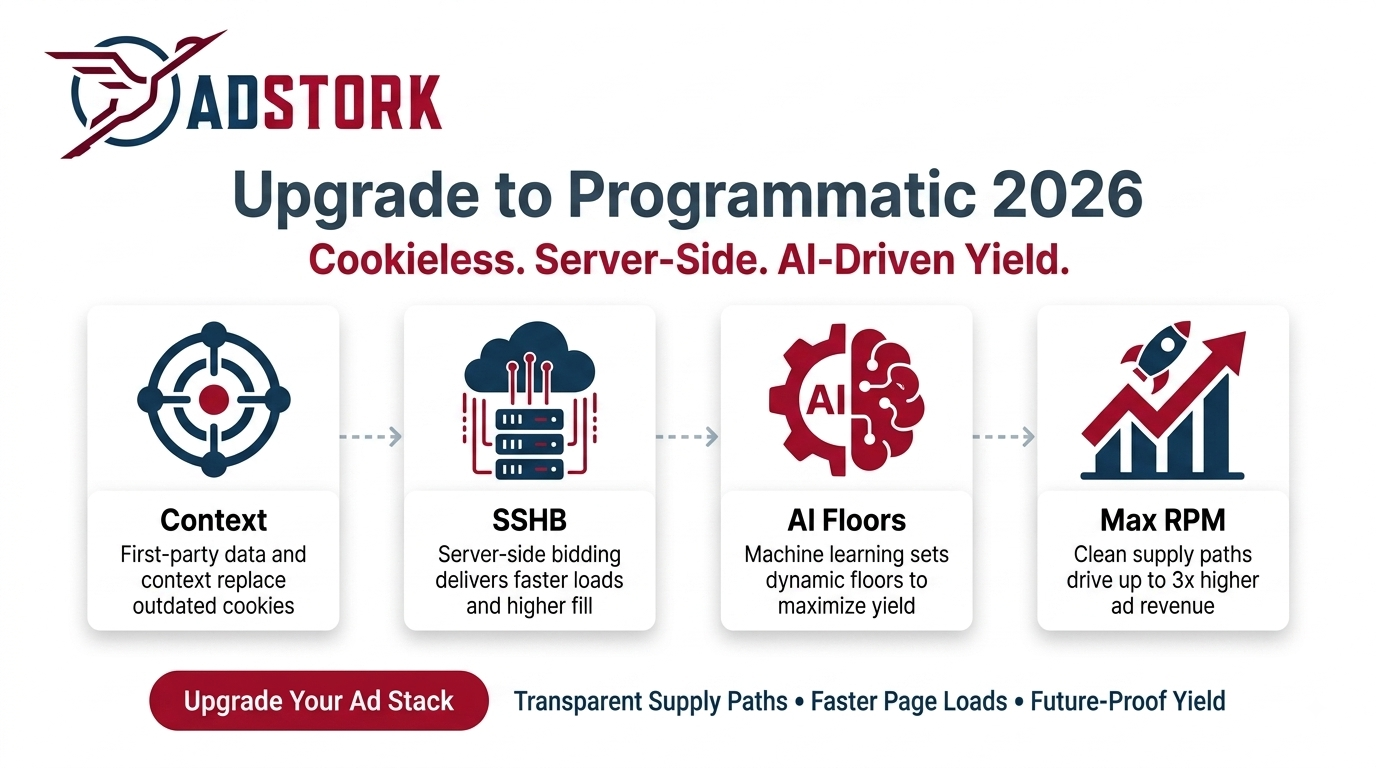
Imagine waking up to find half your ad inventory unfilled and your CPMs down 30%, all while your traffic stays flat. That is the reality for publishers ignoring the tectonic shifts in programmatic advertising right now.2026 is not 2024. The cookie is crumbling, AI is rewriting bidding strategies, and the old "set it and forget it" ad tag approach is a fast track to revenue decline. Publishers who understand the new programmatic landscape, one governed by contextual signals, server‑side header bidding, and supply path optimization, are already seeing RPM gains of 15‑25% over slower competitors.This guide breaks down what has changed, what has stayed the same, and the concrete steps you need to protect and grow your ad revenue this year and beyond.Key TakeawaysThird‑party cookies are effectively gone; contextual targeting and first‑party data are your new revenue anchors.Server‑side header bidding (SSHB) outperforms client‑side setups with faster load times and higher fill rates.Supply path optimization (SPO) is no longer optional; you must actively manage which exchanges you route through.AI‑powered dynamic floors increase CPMs by 10‑20% without sacrificing fill rates.Publishers who adopt multi‑format programmatic strategies see 2‑3x RPM growth compared to single‑format sites.What Is Programmatic Advertising in 2026?At its core, programmatic remains the automated buying and selling of digital ad inventory through real‑time auctions. When a user visits your site, an auction occurs in milliseconds, with multiple demand sources bidding for the right to show an ad. The highest bid wins, and the ad loads before the user registers a delay.What has changed is the currency of the auction. In 2024, the primary signal was the user's browsing history, enabled by third‑party cookies. In 2026, that signal is largely absent. The auction now runs on contextual signals, page topic, keywords, sentiment, first‑party data, user behavior on your own site, and predictive AI models that estimate conversion likelihood without invasive tracking.For publishers, this is a power shift. You are no longer a passive inventory supplier. Your content and audience relationships are now the primary valuable assets in the auction. Advertisers are paying a premium for safe, contextually relevant environments, not for fragmented user profiles collected across the web.Neuromarketing insight: people respond more positively to ads that match their immediate context than to ads that track their past behavior. Contextual relevance triggers a fluency heuristic, where the ad feels natural and unobtrusive, reducing defensive resistance. Publishers who optimise for contextual alignment are tapping into a psychological acceptance that cookie‑based ads never achieved.The Three Pillars of Programmatic Success in 2026To thrive, you need to master three interconnected pillars: supply path optimization, server‑side header bidding, and AI‑driven pricing. Each builds on the others, and failing at any single pillar will cap your revenue.Supply Path Optimization (SPO) is the practice of reviewing and pruning the number of intermediaries between your inventory and the final buyer. Every extra hop takes a cut. In 2026, advertisers actively demand short‑path buys. Publishers who offer clean, transparent supply paths win higher CPMs because buyers trust they are not paying for diluted inventory. Audit your ad stack and remove any exchange that does not provide clear demand transparency.Server‑Side Header Bidding (SSHB) has largely replaced client‑side (browser‑based) bidding. In the old model, multiple bidders ran JavaScript in the user's browser, slowing page loads. SSHB moves the auction to the server, where your ad server calls all demand partners simultaneously without touching the user's device. The result is faster page loads, higher viewability, and the ability to include more bidders without performance penalties. Publishers who switched to SSHB in late 2025 reported an average 12% increase in effective RPM.AI‑Driven Dynamic Pricing replaces static CPM floors. Machine learning models analyze each impression in real time, factoring in device, geography, time of day, and even the article's engagement metrics. The algorithm sets a floor price that maximises yield without collapsing fill rates. Early adopters have seen CPM increases of 10‑20% across the board, with finance and health niches seeing gains over 30%.These pillars are not theoretical. Adstork's platform is built on SSHB by default, with integrated SPO reporting that shows exactly which demand partners contribute to your revenue and at what cost. The dashboard also includes AI‑powered floor recommendations that update every hour based on real‑time auction data. See how Adstork's programmatic stack compares to other networks and why publishers are migrating their full inventory to a single, transparent wrapper.Industry Insight: What the Data Shows in 2026Analysis across over 500 publisher sites in the Adstork network reveals a clear divergence. Publishers who embraced SSHB and SPO saw effective RPM increase by an average of 18% between Q4 2025 and Q2 2026, while those sticking with client‑side bidding experienced a 7% decline. Advertisers are actively routing budgets toward publishers with verified, cookie‑resilient supply, and they pay a premium for brand‑safe contexts.Another finding: publishers who diversified beyond display, adding native and video into the same unified auction, achieved 2.4 times higher overall RPM than those running display only. Video and native ads command higher CPMs, and programmatic buyers actively seek these formats. If your ad stack cannot serve video programmatically, you are leaving money on the table.Comparison Table: Programmatic vs. Traditional Direct DealsUnderstanding why programmatic is becoming the default requires comparing it against direct sold inventory across the dimensions that matter most to your revenue and operations.MetricProgrammatic (2026)Direct DealsTransaction SpeedMilliseconds (real‑time)Days to weeks (negotiation)CPM Range$1 – $15+ (dynamic)$5 – $50+ (fixed)Fill Rate85‑98% (with optimal SPO)Limited to booked campaignsAudience TargetingContextual + first‑partyPublisher defined + customOperational OverheadLow (automated)High (sales + ad ops)Forecast AccuracyModerate (real‑time fluctuations)High (guaranteed placements)Future Outlook: Beyond 2026The current shift is just the beginning. By 2027, programmatic auctions will become predictive, with AI models not just bidding but generating ad creatives in real time based on page content and sentiment. Connected TV and in‑app programmatic are also converging with web inventory, and a single request will serve ads across devices, with algorithms choosing the best fit for the user's context.Retail media programmatic is another rising wave. E‑commerce publishers are embedding programmatic auctions directly into product pages, generating RPMs that dwarf traditional content sites. Content publishers can replicate this by adding affiliate‑linked programmatic units that show products related to the article, earning both ad revenue and commissions from the same impression.Programmatic advertising in 2026 is not a single technology; it is a complete rethinking of how publishers and advertisers connect. The winners will embrace transparency, automation, and contextual intelligence. The losers will cling to outdated tracking and fragmented ad stacks.You do not need to build this from scratch. Adstork offers a fully managed programmatic solution with SSHB, SPO reporting, AI dynamic floors, and multi‑format support in one dashboard. Our publishers have already migrated to the 2026 standard and are seeing the revenue gains to prove it. Start your free Adstork trial today and let our team run a free programmatic audit of your current setup. We will show you exactly where your revenue leaks are and how to fix them within 48 hours.Your immediate action plan: Audit your current header bidding setup. If you are still on client‑side, request a server‑side migration from your ad partner or switch to a network that offers it by default. Next, review your exchange partners and cut any that do not provide detailed SPO logs. Finally, enable dynamic pricing and run a two‑week A/B test against your static floors. Share your results and we will feature the best case studies in our upcoming publisher success series.Frequently Asked QuestionsIs programmatic advertising still profitable without third‑party cookies? Yes, and often more profitable for quality publishers. The cookie‑less auction relies on contextual and first‑party signals, which value your content directly. Advertisers are shifting budgets to publishers with strong contextual relevance, and CPMs for premium content are rising, not falling.How does server‑side header bidding affect page speed? Positively. Moving the auction from browser to server eliminates the JavaScript execution that slowed page loads. Publishers who migrated to SSHB saw an average 20% improvement in Largest Contentful Paint (LCP), which also benefits SEO.What is supply path optimisation and why should I care? SPO reduces intermediaries between you and the advertiser. Each intermediary takes a fee, so shorter paths mean higher revenue for you and lower costs for buyers. Advertisers actively prioritise publishers with transparent, short supply paths.Can small publishers benefit from programmatic in 2026? Absolutely, but you need a partner that handles the complexity. Full‑scale programmatic with SSHB and SPO is technically intensive for small teams. Look for an ad network that bundles these capabilities into a single integration.What is the biggest mistake publishers make with programmatic? Relying on a single demand partner and ignoring SPO. Even with great technology, if you route through too many intermediaries or depend on one buyer, you leave revenue on the table.Keep reading: • How to Double Your Ad Revenue Without Increasing Traffic • Popunder Ads vs. Interstitial Ads: Which Pays More for Publishers? • Why Is My Website Ad Revenue So Low? 10 Problems Publishers Should Check
Read More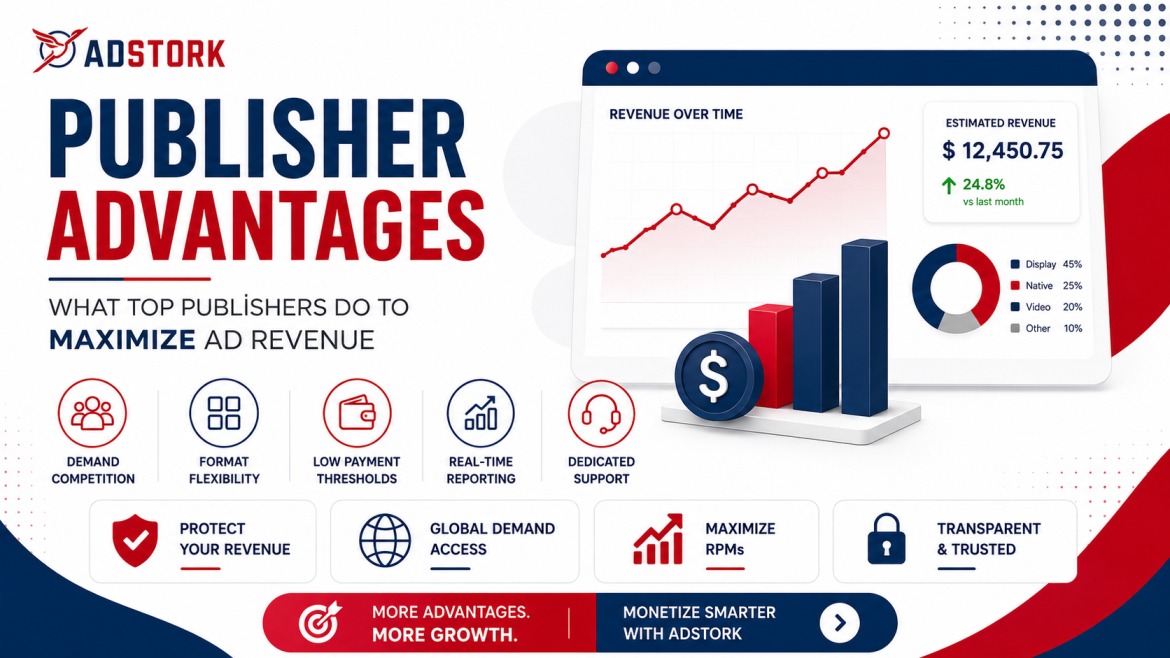
-
13 Aug, 2026
Publisher Advantages: What Top Publishers Do to Maximize Ad Revenue
Most publishers spend months building an audience, only to let a handful of banner ads quietly underpay them for years. Nobody tells them there is a better way, mostly because they never look past the first ad network they signed up with.The publishers who actually grow revenue year over year are not the ones with the most traffic. They are the ones who know what advantages are available and actually use them.In short: Publisher advantages are the tools, strategies, and partnerships that let website and app owners earn more from existing traffic, including demand competition, flexible formats, transparent reporting, and fraud protection. Knowing how to use them separates publishers who plateau from publishers who scale.Key TakeawaysMore traffic does not automatically mean more revenue. Active management does.Real-time, transparent reporting gives publishers pricing control, not just visibility.Low payment thresholds matter more for smaller publishers than headline CPM numbers.Fraud protection directly protects revenue that has already been earned.1. Why Most Publishers Undersell Their Own TrafficA large share of publishers set up one ad network early on, see some revenue land, and never revisit the decision again. That single choice quietly caps their earnings for years. Traffic value shifts as audience size grows and advertiser demand changes, so a setup that made sense at 10,000 monthly visitors rarely makes sense at 500,000.2. What Real Publisher Advantages Look LikeDemand competition – multiple advertisers bidding on the same inventory instead of one fixed buyer setting the rate.Format flexibility – access to display, native, video, and push so publishers can match ad type to content type.Low payment thresholds – faster, more predictable payouts, especially for newer or mid-size publishers.Real-time reporting – seeing what is earning and adjusting the same day instead of waiting on a monthly report.Dedicated support – an actual point of contact when a placement underperforms.3. What Publishers Can Do to Capture These AdvantagesAudit placements quarterly. What worked at launch rarely stays optimal as content and audience behavior evolve.Test more than one format. Display-only setups almost always underperform a mix of native, video, and display.Compare demand sources instead of settling for one. A single fixed-rate buyer will rarely beat multiple sources competing for the same slot.Watch fill rate alongside CPM. A strong rate on half your impressions earns less than a modest rate on all of them.4. Where Adstork Fits InThis is exactly the gap many publishers do not realize they are stuck in. Adstork gives publishers access to multiple competing demand sources instead of one fixed buyer, backed by a dedicated account approach so placement and format decisions are not left to guesswork. Low payment thresholds and real-time, transparent reporting mean publishers see exactly where revenue comes from and can act on it immediately.It is built around a simple idea: a publisher's traffic is worth more when it has real competition behind it.5. Common Mistakes That Cost Publishers RevenueStaying with the first ad network signed up with, regardless of performance.Ignoring mobile placements as mobile traffic share keeps growing.Chasing the highest advertised CPM without checking actual fill rate.Being Honest About the Trade-offsSwitching networks or testing new formats takes time, and results are rarely immediate. Publishers who benefit most test in small increments rather than expecting one change to fix everything overnight. A good network partner shortens that learning curve by handling the technical setup and offering guidance based on what has worked for similar sites.Publisher Advantage ComparisonAdvantageSingle Network SetupCompeting Demand SetupPricingFixed rate set by one buyerRate driven by real-time biddingFill RateLimited to one buyer's demandHigher, backed by multiple buyersReportingOften delayed or limitedReal-time, transparentPayout FlexibilityVaries, often high thresholdsLower thresholds, more controlWhat's Next for Publisher AdvantagesAs third-party cookies phase out, publishers who invest in first-party data and direct audience relationships will hold more leverage, not less. Contextual targeting is regaining relevance, which favors publishers since it rewards well-organized content over invasive tracking.Final WordPublishers who earn the most are not the ones with the biggest audience. They are the ones who actively use the advantages available to them: competing demand, flexible formats, transparent data, and a partner invested in their growth. At Adstork Ad Network, that partnership is the entire point.Ready to see what your traffic is actually worth? Partner with Adstork Ad Network today.FAQsWhat are publisher advantages in ad networks? The tools and strategies, such as demand competition, format flexibility, and transparent reporting, that let publishers earn more from existing traffic.How can publishers increase revenue without more traffic? By optimizing placement, diversifying formats, and using multiple competing demand sources instead of one fixed-rate buyer.Why does fill rate matter as much as CPM? A high CPM on unsold impressions earns nothing. Fill rate determines how much of that rate is actually captured.What payment threshold should publishers look for? Lower thresholds generally suit newer or mid-size publishers better, allowing faster, more predictable payouts.How does Adstork help publishers specifically? By connecting inventory to multiple competing demand sources, offering real-time reporting, and providing dedicated support for placement and format decisions.Suggested Internal LinksPublisher Monetization Tips: How to Earn More From Your Website TrafficHeader Bidding ExplainedAd Fill Rate: Why It Matters More Than CPMNative Advertising for PublishersFirst-Party Data and the Cookieless FuturePublisher Monetization Tips: How to Earn More From Your Website Traffic
Read More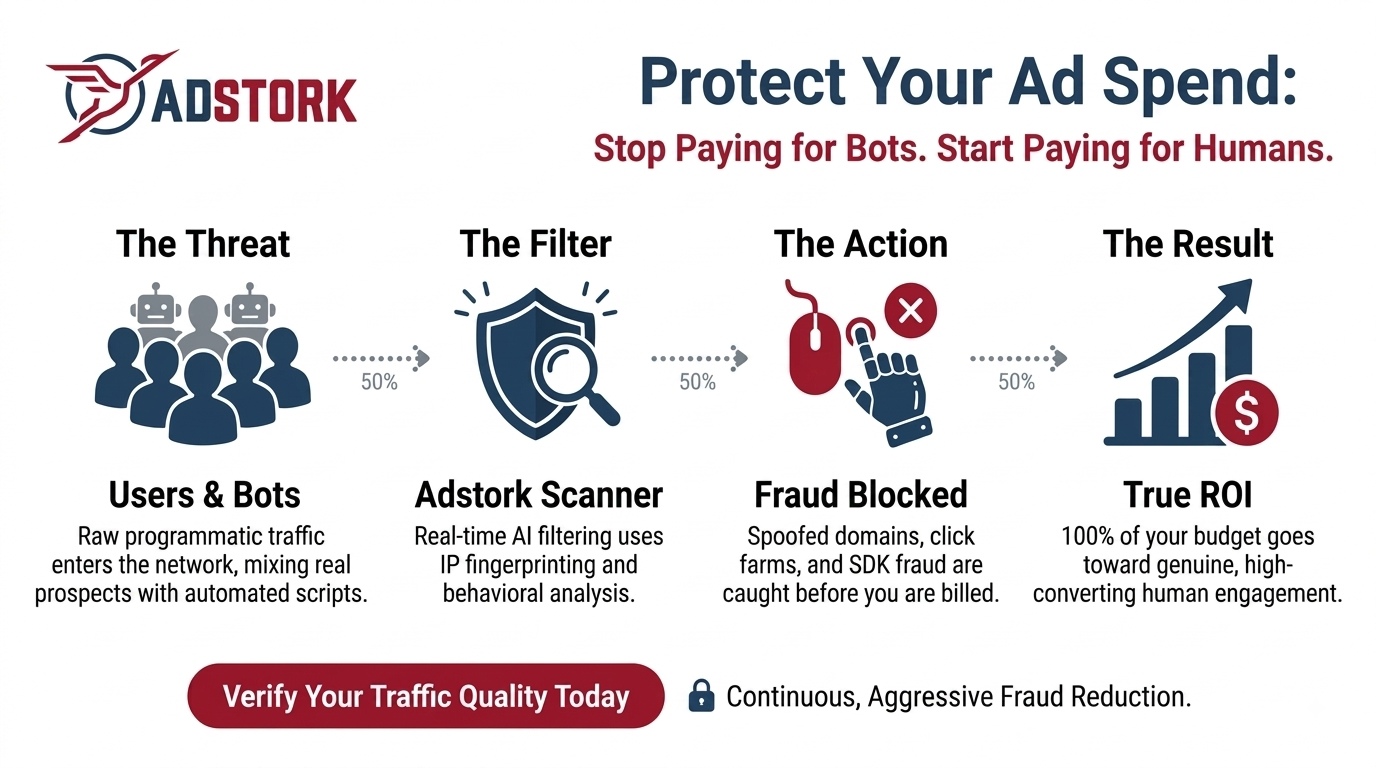
-
12 Aug, 2026
Ad Fraud & Bot Traffic Prevention: How to Protect Your Ad Spend
You launch a campaign. Impressions climb, clicks come in, the dashboard looks healthy. Then the conversions never show up. Somewhere between the numbers and the results, the budget just disappeared.This is the quiet reality behind a huge share of digital ad spend. Ad fraud is the deliberate manipulation of ad metrics, usually through bots, click farms, or spoofed domains, to fake impressions, clicks, or conversions that no real person ever generated. It costs advertisers billions every year and is one of the most underestimated threats to campaign ROI.Key TakeawaysFraud is a structural cost of unprotected programmatic buying, not a rare eventBots can fake impressions, clicks, and even app installs at scaleIt hurts both sides: advertisers lose budget, honest publishers lose trust and payoutsDetection relies on behavioral analysis, fingerprinting, and real-time filteringNo network eliminates fraud fully. The goal is aggressive, continuous reduction1. Why Fraud Is So Easy at ScaleProgrammatic advertising runs on speed. Billions of impressions are bought and sold in milliseconds, with almost no human review. That is what makes it efficient, and exactly what makes it exploitable. A bot does not need to fool a person, only a script. Multiply one bot across a botnet of thousands of devices, and a single operator can fake the impression volume of a real mid-size publisher.2. Common Types of Ad FraudBot traffic – automated scripts fake pageviews and impressions, sometimes mimicking scroll and click behavior to slip past basic filtersClick fraud – repeated fake clicks drain budgets or generate fraudulent affiliate revenueDomain spoofing – low-quality sites disguise themselves as premium publishers to charge premium CPMsAd stacking / pixel stuffing – multiple ads layered invisibly so one slot bills several impressions no one sawSDK spoofing – fake app installs and in-app events, mainly hitting mobile performance campaigns3. Who Gets HurtAdvertisers – they burn budget on impressions and clicks no real prospect ever saw, inflating true CPAPublishers – genuine, high-traffic sites get undercut when fraudulent inventory drags down market pricingNetworks – they lose advertiser trust fast in a market where budget can move to a competitor in one clickA common misconception is that fraud only hits cheap, obscure networks. In reality, spoofing specifically targets premium-looking inventory because advertisers scrutinize it less.4. How Detection Actually WorksBehavioral analysis – flags inhuman patterns like identical click timing or zero scroll activityIP/device fingerprinting – blocks known data-center IPs and bot-farm device signaturesTraffic source verification – confirms the claimed publisher domain matches the real ad request originMachine learning models – score traffic in real time and adapt to new fraud patternsPost-bid analysis – cross-checks delivered impressions against engagement data after the fact5. Fraud Type ComparisonFraud TypeWhat It FakesHurts MostPrimary DefenseBot TrafficImpressionsAdvertisersBehavioral + IP analysisClick FraudClicksAdvertisersClick pattern checksDomain SpoofingPublisher identityAdvertisers, honest publishersads.txt verificationAd StackingViewabilityAdvertisersPost-bid auditSDK SpoofingApp installsPerformance advertisersDevice fingerprinting6. Best Practices for AdvertisersChoose networks that disclose their fraud-filtering methodology, not vague promisesWatch for abnormal CTR, both suspiciously high and suspiciously lowSet frequency caps and dayparting rulesRequest traffic quality reports, not just delivery numbersWhere Adstork Fits InThis is the gap Adstork was built to close. Every impression passes through anti-fraud algorithms that catch invalid traffic before it is ever billed, backed by comprehensive analytics so advertisers can verify quality themselves, not just take our word for it. For publishers, the same filtering protects payout integrity by keeping genuine, high-traffic sites from being priced out by fraudulent competitors.No honest network can promise zero fraud. It is an arms race, and some sophisticated bots will slip through. The real commitment is catching it early, filtering aggressively, and staying transparent when something gets through.What's NextAs third-party cookies phase out, fraud detection is shifting toward first-party data and contextual signals instead of pure behavioral tracking. AI-driven anomaly detection is getting faster, but fraud tactics keep adapting too, which keeps traffic quality a real differentiator between ad networks.Final WordFraud is the tax nobody budgets for. It hides inside metrics that look fine until the ROI does not add up. At Adstork Ad Network, we treat traffic quality as infrastructure, not an afterthought, combining anti-fraud technology with full transparency so your spend goes toward real people, not scripts.Ready to stop paying for traffic that was never really there? Partner with Adstork Ad Network today.FAQsWhat is ad fraud? The use of bots, click farms, or spoofed domains to fake impressions, clicks, or conversions.How much does it cost advertisers? Industry estimates put global losses in the tens of billions annually.How can I tell if my traffic is fraudulent? Watch for abnormal CTR, odd-hour traffic spikes, and sessions with no real engagement.Does fraud only hit low-budget campaigns? No, premium inventory is a common spoofing target precisely because it is trusted more.Can fraud be fully eliminated? No network can promise that. The goal is continuous, aggressive reduction.How does Adstork prevent fraud? Anti-fraud algorithms filter invalid traffic before billing, backed by transparent analytics.
Read More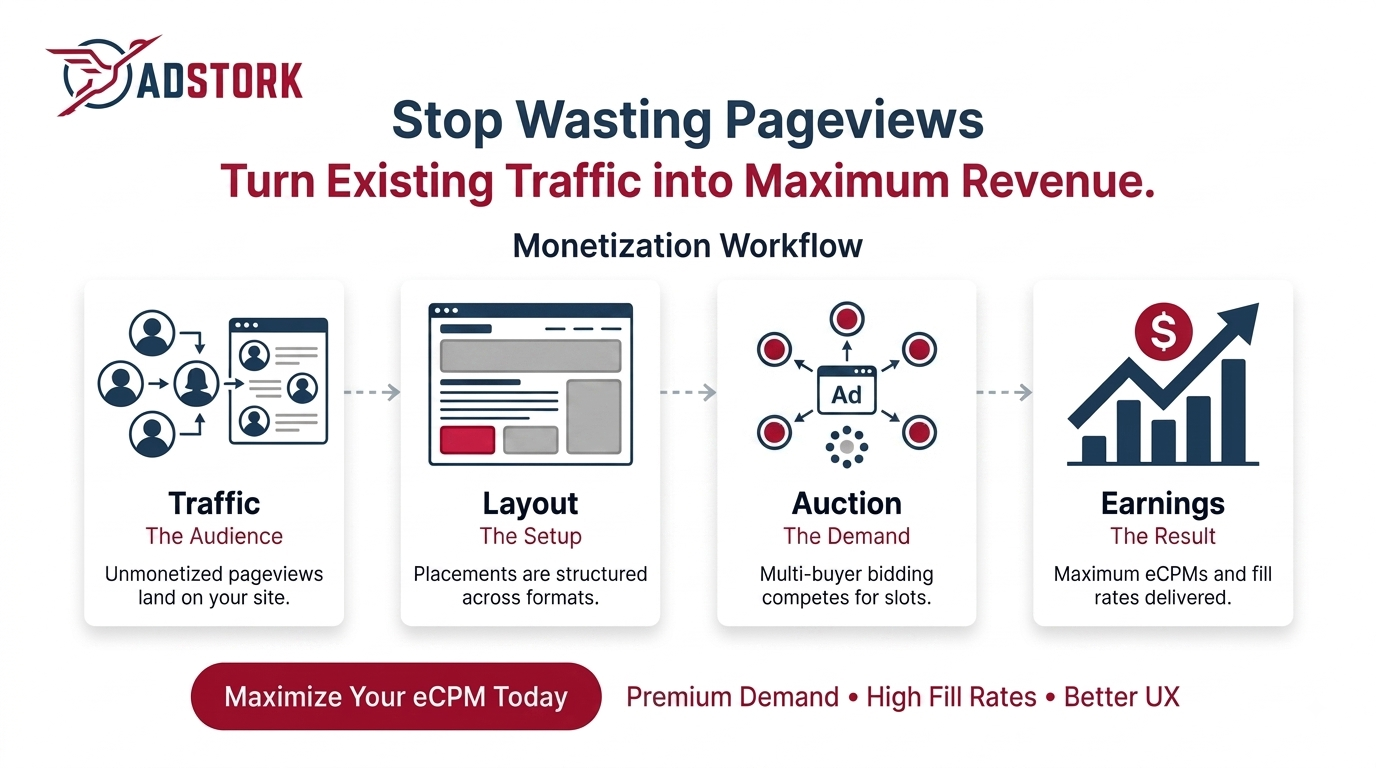
-
12 Aug, 2026
Publisher Monetization Tips: How to Earn More From Your Website Traffic
Your traffic is growing. Pageviews are up, engagement looks solid, but revenue barely moves. It is one of the most frustrating spots a publisher can be in: the audience is there, but the money is not following.Usually, it is not a traffic problem. It is a monetization problem.In short: Publisher monetization is the process of turning website or app traffic into ad revenue through strategies like ad placement optimization, format diversification, and demand competition (like header bidding). Done right, it can lift revenue significantly without adding a single extra visitor.Key TakeawaysMore traffic does not automatically mean more revenue. Optimization matters more than volume.Ad placement, format mix, and fill rate all directly impact eCPM.Competing demand sources, like header bidding, consistently outperform single-network setups.Over-monetizing hurts user experience and long-term revenue. Balance is critical.The right ad network partner can boost earnings without extra development work.1. Why Traffic Growth Alone Does Not Pay OffNot all impressions are equal. A visitor who bounces in three seconds generates a different value than one who stays and scrolls. If your ad setup is not built to capture engaged attention, then with the right placement, format, and timing, you are leaving money on every single pageview, no matter how much traffic you drive.2. Fix Your Ad Placement FirstPlacement is usually the single biggest lever.Above the fold – highest visibility, highest eCPM, but do not overload it.In-content (between paragraphs) – strong engagement without disrupting reading.Sticky/anchor units – stay visible during scroll, good for mobile.Avoid stacking too many units – it hurts load speed and user experience, which quietly kills long-term revenue.3. Diversify Your Ad FormatsRelying on one format caps your ceiling. A mix typically performs best:Display – reliable baseline revenue.Native – blends with content, strong CTR, less intrusive.Video – highest eCPM per impression, best for engaged pages.Push/interstitial – high revenue but use sparingly; overuse drives users away.4. Let Demand Sources Compete for YouThis is the single biggest technical upgrade most publishers skip. Instead of selling inventory to one buyer at a fixed rate, header bidding lets multiple advertisers bid simultaneously for the same ad slot in real time.Higher competition leads to higher eCPM.No dependency on a single network's fill rate.Removes the "waterfall" delay of asking buyers one at a time.5. Watch Your Fill Rate, Not Just Your CPMA high CPM means nothing if half your impressions go unsold. Fill rate; the percentage of ad requests actually filled with an ad is just as important as the rate you are paid per impression. Low fill rate is often a sign of too narrow a demand pool.Monetization Model ComparisonModelBest ForPublisher EarnsTrade-offCPMHigh-traffic, brand pagesPer 1,000 viewsNeeds volume to add upCPCContent/blog sitesPer clickDepends on engagementHeader BiddingAny site with real demandHighest competing bidRequires setup/integrationNativeContent-heavy sitesPer view/clickLower per-unit, high volumeCommon Mistakes Publishers MakeOverloading pages with ads, tanking page speed and user retention.Sticking to one demand source instead of letting buyers compete.Ignoring mobile-specific placements, where a huge share of traffic now lands.Never testing placement changes. Treating the ad setup as "set and forget."Where Adstork Fits InThis is exactly where a good network partner changes the math. Adstork connects publishers to premium, non-intrusive ad inventory and competing demand sources, so instead of settling for one buyer's rate, your inventory gets matched against real competing bids. Combined with anti-fraud filtering, that also means the traffic you are being paid for is traffic that actually counts, protecting the payouts you have already earned.It is not about cramming more ads onto the page. It is about making every existing impression worth more.Being Honest About the Trade-offsMore ad units or more intrusive formats can boost short-term revenue, but they cost you engagement, page speed, and repeat visitors over time. The publishers who monetize best long-term are not the ones who fill every pixel with an ad; they are the ones who treat user experience as part of the revenue equation, not separate from it.What's Next for Publisher MonetizationAs third-party cookies fade out, contextual targeting and first-party data are becoming the new backbone of publisher revenue rewarding sites that build direct audience relationships rather than relying purely on tracking-based ads.Final WordGrowing traffic is only half the job. The other half is making sure every visitor you already have is monetized properly through smarter placement, diversified formats, and real demand competition. At Adstork Ad Network, we help publishers do exactly that, turning existing traffic into meaningfully higher revenue.Ready to earn more from the traffic you already have? Partner with Adstork Ad Network today.FAQsWhat is publisher monetization? Turning website or app traffic into ad revenue through optimized placement, formats, and demand sources.What's the fastest way to increase ad revenue? Diversifying demand sources through header bidding usually has the biggest immediate impact.Does more traffic always mean more revenue? No, unoptimized placement and format choices can leave significant revenue on the table regardless of traffic volume.What is fill rate? The percentage of ad requests that are actually filled with an ad, distinct from the rate paid per impression.Can too many ads hurt revenue? Yes, overloading pages slows load speed and drives users away, hurting long-term earnings.How does Adstork help publishers earn more? By connecting inventory to competing demand sources and filtering out fraudulent traffic that erodes payouts.
Read More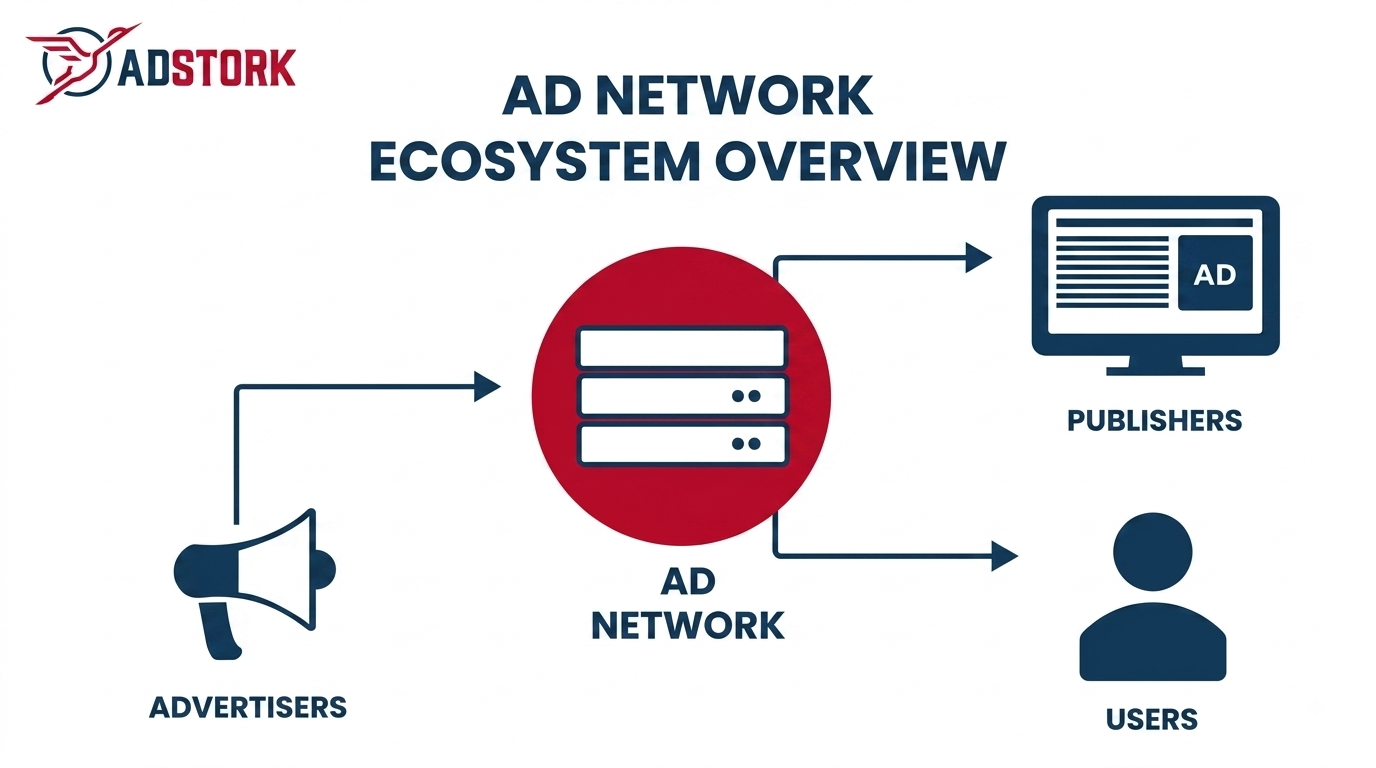
-
17 Dec, 2025
The Role of Ad Networks in Shaping the Future of Digital Advertising
In today’s rapidly evolving digital landscape, ad networks play a pivotal role in shaping how advertisers connect with their target audiences. These platforms act as crucial intermediaries between advertisers seeking exposure and publishers offering ad space, streamlining the complex process of digital media buying and selling.By aggregating vast amounts of ad inventory across websites, mobile apps, and digital platforms, ad networks allow advertisers to launch scalable campaigns that are both cost-effective and performance-driven. Through advanced audience targeting, real-time bidding (RTB), and optimization tools, they ensure that each impression is delivered to the right user, at the right time, and in the right context.Ad networks also provide valuable infrastructure for measuring success like tracking impressions, clicks, conversions, and more. With billions of ad impressions served daily, these networks have become the backbone of programmatic advertising, helping brands reach wider audiences while maximizing ROI.As digital advertising continues to move toward automation, personalization, and cross-platform delivery, ad networks are no longer just optional—they are essential. Their ability to bridge the gap between demand and supply, while adapting to privacy regulations and evolving user behavior, positions them as key drivers in the future of online advertising. Ad Networking in the Modern MarketToday’s advertising environment is dynamic, data-driven, and evolving at record speed. What was once a manual, relationship-based industry has transformed into an automated ecosystem powered by real-time technologies and intelligent algorithms.At the heart of this transformation are programmatic tools like Real-Time Bidding (RTB), Supply-Side Platforms (SSPs), and Demand-Side Platforms (DSPs). These components work together to automate and optimize the process of buying and selling ad impressions. Rather than relying on traditional direct deals, advertisers now use DSPs to bid on individual impressions in real time, while publishers leverage SSPs to maximize the value of their available ad inventory. This highly efficient exchange takes place on ad exchanges, where each impression is auctioned within milliseconds delivering speed, scale, and precision that manual trading could never achieve.However, with this technological leap comes a new set of responsibilities. In a privacy-first advertising era, ad networks must now balance performance with regulatory compliance and user trust. The deprecation of third-party cookies, introduction of frameworks like GDPR and CCPA, and a growing demand for transparency and data control have reshaped how campaigns are run.To adapt, modern ad platforms are pivoting toward first-party data strategies, contextual targeting, and AI-powered optimization. These advancements not only help advertisers maintain reach and relevance but also ensure that user privacy is respected throughout the journey. Machine learning models are now used to analyze user behavior patterns, predict intent, and optimize ad delivery. All without compromising sensitive personal data.In short, the future of digital advertising belongs to intelligent, privacy-aware ad networks that can deliver both performance and accountability at scale. Ad Networking in the Modern MarketThe global programmatic advertising market is experiencing steady year-over-year growth, with billions being spent across formats like display, video, native, and mobile. While major platforms command a significant share of the ecosystem, there’s growing space for agile ad networks that offer flexible pricing models, fraud prevention, transparent reporting, and niche audience targeting.Today’s publishers seek monetization partners that provide greater control, higher fill rates, and real-time insights. At the same time, advertisers are focused on solutions that deliver precise targeting and measurable return on investment (ROI) driving demand for smarter, more responsive ad platforms. How Adstork Enhances the Ad Network ExperienceAt Adstork, we’re more than just a bridge between advertisers and publishers. We’re an intelligent hub that empowers both sides with performance, control, and transparency.For publishers, our integration with leading SSPs ensures premium demand and maximized yield.For advertisers, our DSP tools deliver high-precision targeting, creative flexibility, and real-time optimization.For partners, our platform architecture offers seamless onboarding, reporting, and traffic validation, all within a single, powerful interface.Whether it’s through our direct relationships, self-serve tools, or advanced analytics, Adstork is committed to simplifying and strengthening every step of the ad delivery process.Conclusion: The Future is Programmatic, and Adstork is Built for ItAs the advertising industry accelerates toward automation, personalization, and privacy, the role of ad networks becomes more critical than ever. At Adstork, we’re not just keeping pace with change, we’re driving it. Whether you’re an advertiser seeking conversions or a publisher looking to increase yield, Adstork is your partner for smarter, faster, and more effective advertising.Let’s grow together. The future of advertising starts here.
Read More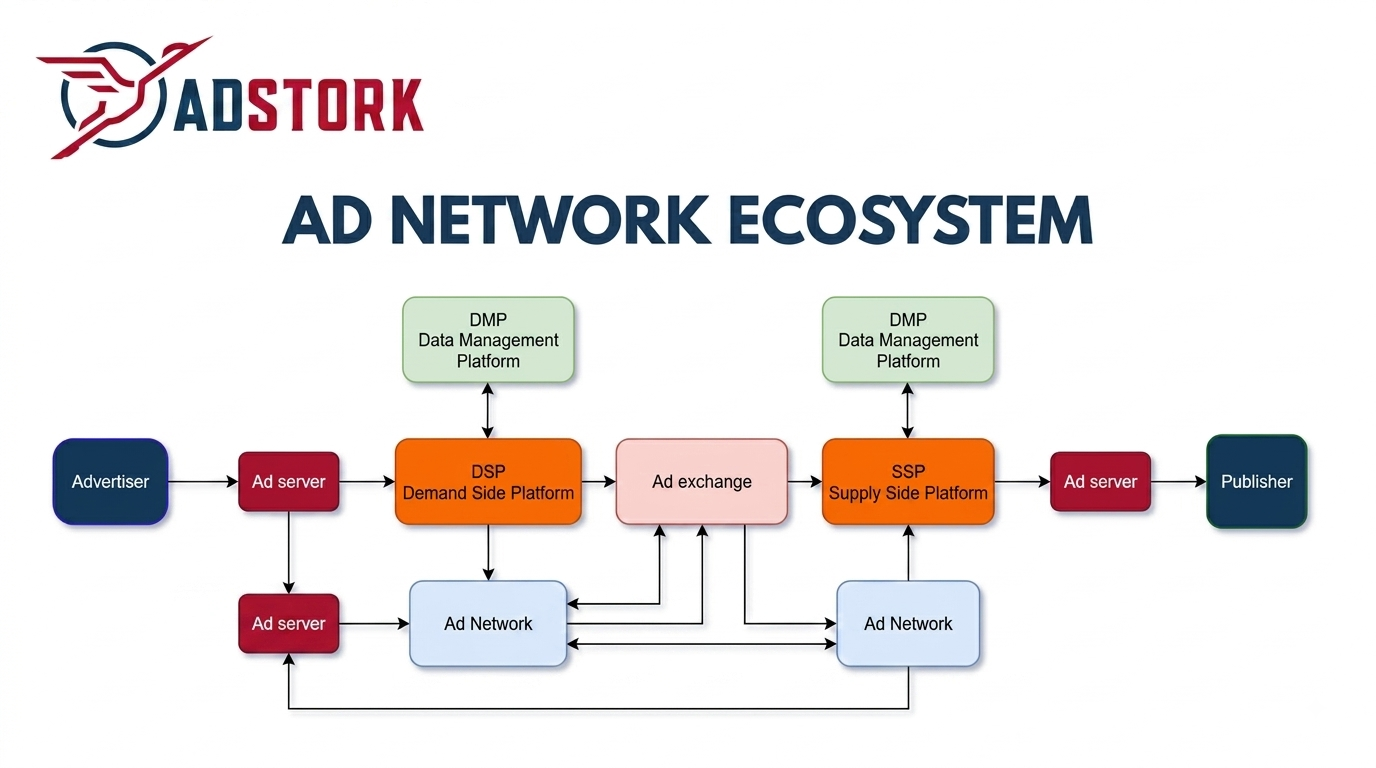
-
17 Dec, 2025
The Ultimate Guide to Ad Network Operations and the Digital Advertising Ecosystem
Digital advertising is no longer as simple as “buy an ad, get a click.”Instead, it has evolved into a highly competitive, multi-layered ecosystem where advertisers chase attention, publishers struggle to monetize, and both sides demand more transparency and performance.At the heart of this system are ad networks — the matchmakers connecting advertisers with publishers. By aggregating inventory and optimizing campaigns, they provide scale, efficiency, and measurable results.But not all ad networks are created equal. Some lack transparency. Some suffer from fraud. Others overwhelm advertisers with too many choices (paradox of choice).This guide breaks down how ad networks operate, the challenges they face, and how smart agencies like Adstork Ad Network are rewriting the rules with trust, innovation, and growth.1. How Ad Networks Operate: The Matchmakers of Digital MediaAd networks are digital connectors. They aggregate ad space from publishers and sell it to advertisers.Typical workflow:Publisher Onboarding → Publishers integrate ad tags/SDKs to make inventory available.Advertiser Setup → Advertisers define goals, budgets, and creatives.Ad Matching & Targeting → Algorithms decide the best audience fit.Ad Serving → Ads delivered in real-time.Reporting & Payouts → Metrics tracked, revenue split, network commission deducted.2. Types of Ad NetworksVertical Networks → Niche categories like gaming, health, or finance.Premium Networks → High-quality publishers, brand-safe environments.Performance Networks → Focused on CPA, CPL, ROI.Format-Specific Networks → Mobile, native, video, or CTV.3. Ad Serving Architecture: Behind the ScenesAd serving is what makes ads appear almost instantly when you load a page.Ad Tags trigger ad requests.Ad Servers choose the right ad.CDNs deliver content globally in milliseconds.Optimization matters: latency (ads must load fast), scalability (traffic spikes handled smoothly), and tracking accuracy.4. Ad Tracking & Analytics: Data is the New CurrencyWhat gets measured gets improved.Impressions → How many times ads displayClicks → Interactions recordedConversions → Actual actions (sign-ups, purchases)Advanced metrics: eCPM, CTR, viewability, attribution.5. Monetization Models: Choosing the Right PathModelAdvertiser PaysPublisher EarnsUse CaseCPMPer 1,000 impressionsPer 1,000 ad viewsAwarenessCPCPer clickPer clickTrafficCPAPer actionConversionE-commerceCPLPer leadLead submissionB2BCPI/CPVPer install/viewInstalls/video completionMobile/Video 6. Key Players in the Ad EcosystemAdvertisers → Set goals, budgets, creatives.Publishers → Provide inventory.Ad Networks → Aggregate and optimize inventory.Ad Exchanges, DSPs, SSPs → Power programmatic transactions.DMPs & CDNs → Manage audience data and ad delivery.Agencies/Brokers → Strategy, media planning, execution.7. Advanced Technologies & AuctionsHeader Bidding → Increases CPM by letting multiple buyers compete.Real-Time Bidding (RTB) → Ads bought in milliseconds.DMPs → Power retargeting and lookalike modeling.8. Challenges in Digital AdvertisingTransparency → Opaque fees erode trust.Ad Fraud → Bots and fake clicks drain budgets.Brand Safety → Risk of appearing in harmful environments.Ad Blocking → Users skipping ads entirely.9. Regulations & PrivacyWith GDPR, CCPA, and privacy-first models, ad networks must respect consent and data ethics.Future opportunities lie in first-party data and contextual targeting. Final WordThe ad network ecosystem can often feel complex and overwhelming, from integrations and targeting to fraud prevention and optimization. At Adstork Ad Network, we simplify it all. By combining cutting-edge technology, full transparency, and proven marketing psychology, we create advertising campaigns that don’t just run. They perform with measurable impact, driving real growth and ROI for publishers and advertisers alike.
Read More